It’s day two in Bhutan and I wake up with a splitting headache. Are you kidding me? Travel dream happening right now and I’m going to get a headache?
Turns out that pounding heart I had at the end of day one wasn’t just excitement. It was the effects of Thimphu’s altitude.
Once again, I have completely failed to consider the elevation of my destination, and with Thimphu at 2,334 meters, it’s high enough up to remind me. I’ve been down this road enough times to know it will pass after a few Excedrin, a lot of water and some patience, but lesson learned, (hopefully). After all the day must go on. I’m in Bhutan and we’ve got things to see and stuff to do.
Thimphu is the capital of Bhutan and its largest city. It has a population of give or take about 100,000 and is also the home of the Royal Family. Thimphu also the home of my guide, Thinley. Thinley majored in human resources but ended up in tourism after he decided sitting behind a computer wouldn’t feed his soul. He speaks with a regal, intelligent, slightly British sounding accent, loves Liverpool Football and Bollywood movies, he’s been with Bhutan Swallowtail for over three years and is one of four siblings who are all working to help provide for their parent’s retirement years. He’s going to be my everything Bhutan for the next week. We are accompanied by Tshering our driver. A sweet sweet man who refers to me as madam, he has a wife and two kids, a boy and a girl, and he keeps wanting to make sure I’m comfortable with his driving. Yes, he’s doing a hell of a better job than I would be doing with everything going on. But we’ll get to that later.
First stop of the day, the Memorial Chorten stupa in Thimphu. This is the most popular stupa in Bhutan and it is bustling. You see, when Bhutanese retire they’re excited because now work doesn’t get in the way of their prayers, and there is no better place to pray in Thimphu than at the Memorial Chorten. I had no idea what a stupa was but turns out understanding a stupa is fundamental to understanding Bhutan. While a stupa is a memorial honoring a beloved deceased, the Memorial Chorten Stupa is that and more. In fact, I’m going to say the Memorial Chorten is kind of like Starbucks: it’s part of your morning ritual where you go to meet your friends and hang out, except there’s more retirees than digital nomads, serves blessings instead of coffee prayers instead of coffee, and enlightenment comes from Buddha not Wi-Fi. Each morning the retirees in Bhutan wake up, grab their prayer beads, and head to the Memorial Chorten to celebrate not having to work anymore and having all the free time in the world to pray until their heart is content. So you show up to the stupa and start moving clockwise through the grounds. First stop of the stupa, the prayer wheels. And should you fancy just chilling with the prayer wheels all day, there are cushions to make you comfy while you do just that. If you’re feeling like getting in your exercise for the day, you move on to the main stupa and get going on walking your 108 rounds around the stupa, or however many you’d like to do, while soaking in the sun, maybe picking up a daily dose of enlightenment and chanting your mantra of choice. Now should you and your best girlfriend need to catch up on the latest with the kids, the grandkids, the Royal Family or the latest on Bhutan’s Got Talent (it’s real), you can still get your blessings and enlightenment provided you can walk, talk and spin your hand-held prayer wheel at the same time. After your rounds around the stupa, on your way out you can stop and do a few touching of the earth prayers in the prostration area and then head off to your day to do whatever is left after all that.

Memorial Choten 
Prayer Wheels 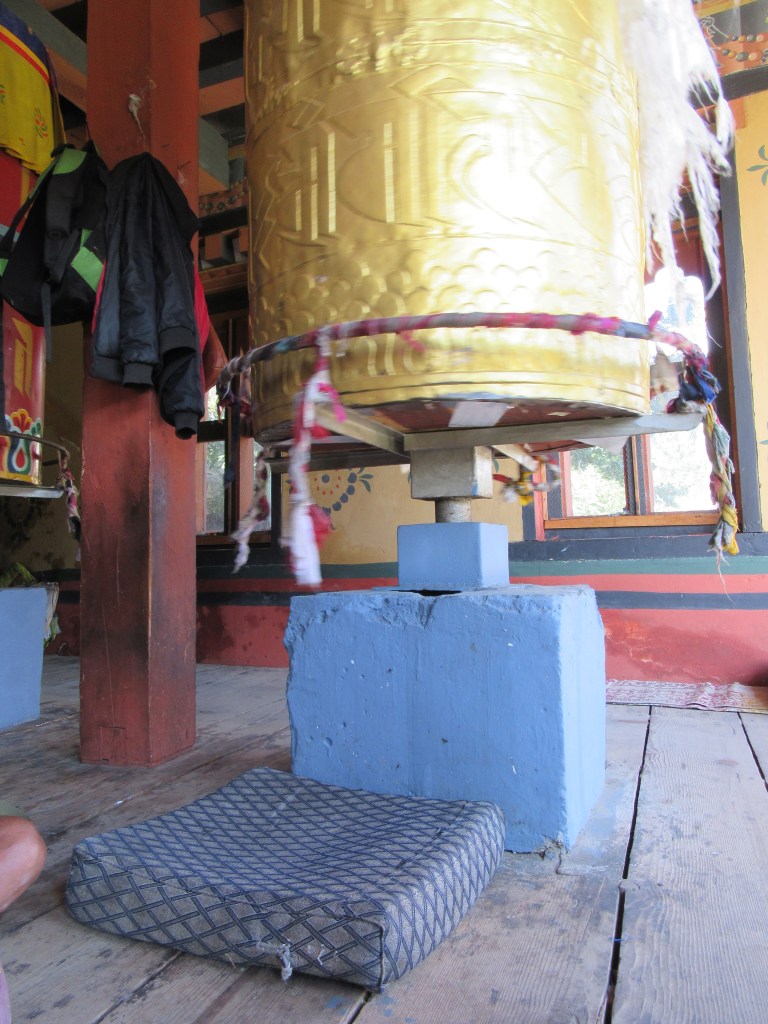
Just sit and get comfy 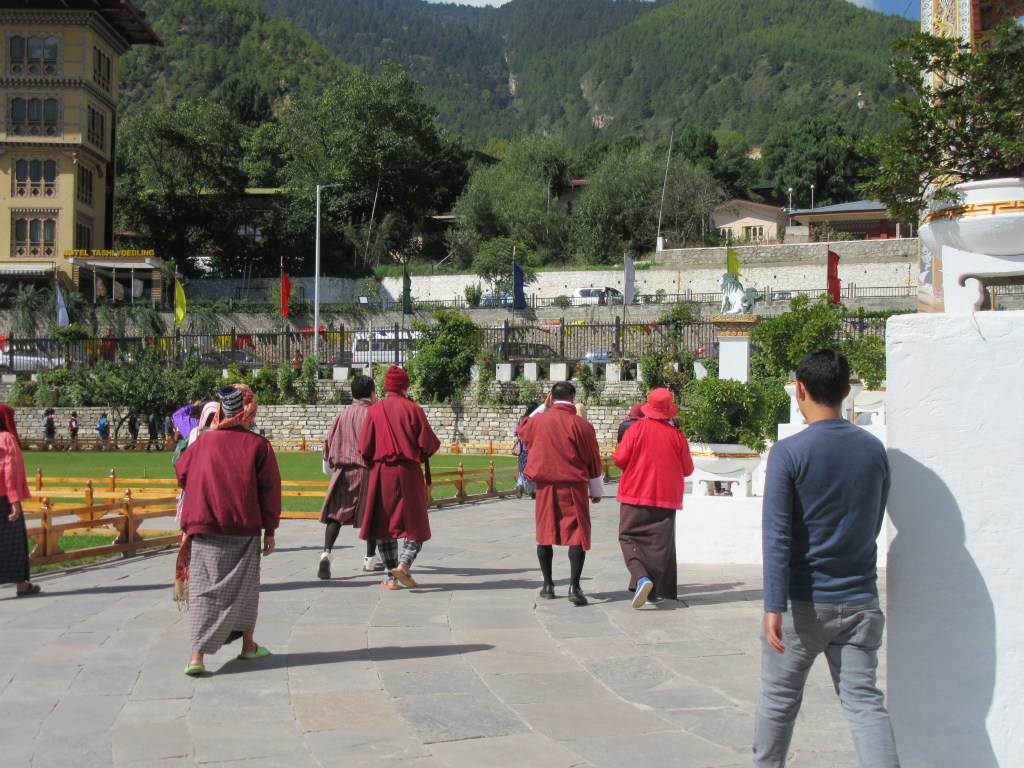
Making the Rounds 
It’s me!
Inside the stupa though is the real magic. It’s so magical in fact you are restricted from taking pictures inside. This is actually the case for every temple in the country, and bravo to that Bhutan. Maintaining the sacredness of holy places as holy places rather than selling them out as tourist photo ops is the perfect example of their emphasis and focus on maintaining the cultural integrity of the country. I’m going to say now that there is no way I can adequately describe the inside of the stupa other than like this – it’s like Buddhist iconography on acid. Sheer fantastical, artistic magnificence in every detailed stroke, color, shape, figure, statue, design, pattern and offering you can see. The insides of the temples are designed by a spiritual master who reads and interprets the scriptures and then offers his visions to the artists who put the interpretative vision into form. The amount of detail is extraordinary and every single line, color and shape has layers and layers of spiritual significance. It’s extraordinary, incredible and a little overwhelming. I could only find one picture online of one very small figure from inside the stupa and all I can say is take this and multiply it by 1,000 and you’re starting to get close.
Next stop. The really big Buddha.
Now when I say big Buddha, I mean a really, really big Buddha. At first take, I figure the big Buddha, more formally known as the Buddha Dordenma, has to be the biggest Buddha in the world, but it’s not. But man, it is so big I really can’t imagine how big the biggest Buddha in the world would be. All I can say is this one is plenty big for me. Turns out this Buddha was built by a Hong Kong based company in 2015 in hopes of paying respect to the motherland of the many Bhutanese monks now living and teaching in China and Taiwan, as well as to fulfill the prophecy of a large Buddha overlooking the Thimphu valley. The temple inside the big Buddha definitely has a different design and feel than the Memorial Chorten. It’s more modern, refined and offers a different type of experience. Thinley tells me it’s Chinese in style. That makes sense. The whole thing seems a bit random to me that a Chinese company would build such a big Buddha in another country, but hey, the world is a funny place. Now all this wonder aside, perhaps the most memorable part of the visit to the Big Buddha happened as we were driving up to the site. As we got close and turned a corner to get the first clear and direct view of the big Buddha, Tshering briefly let Buddha take the wheel while he used his hands to offer a quick prayer. Welcome to Buddhist Country.
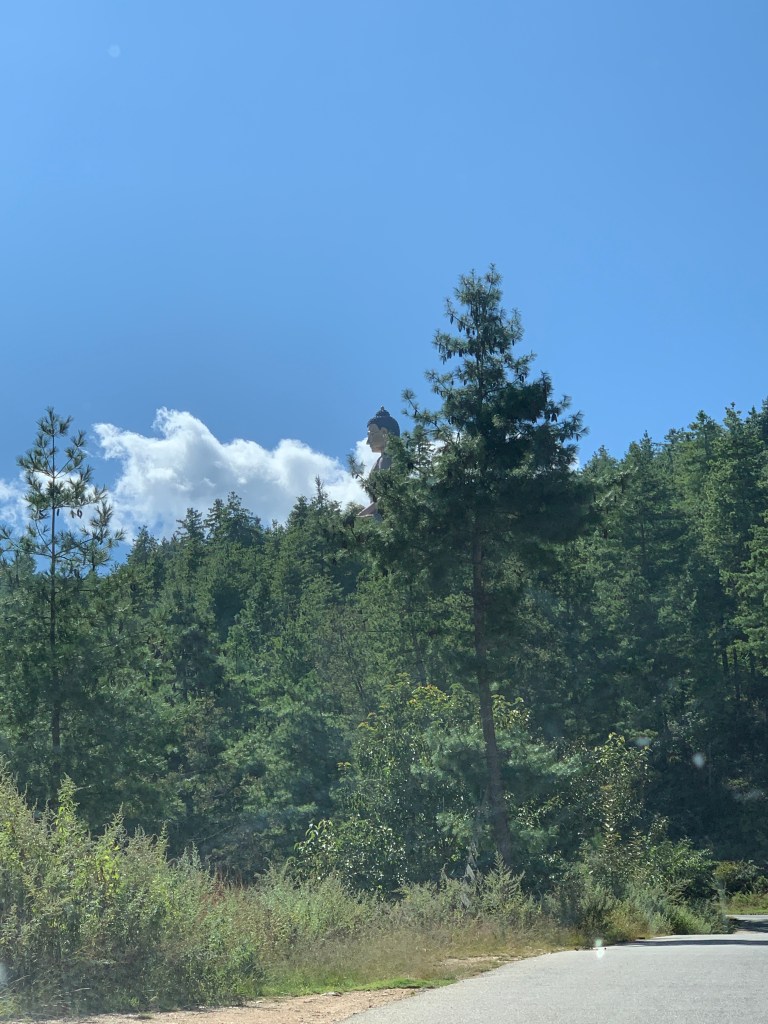
This is when Tshering offered his prayer 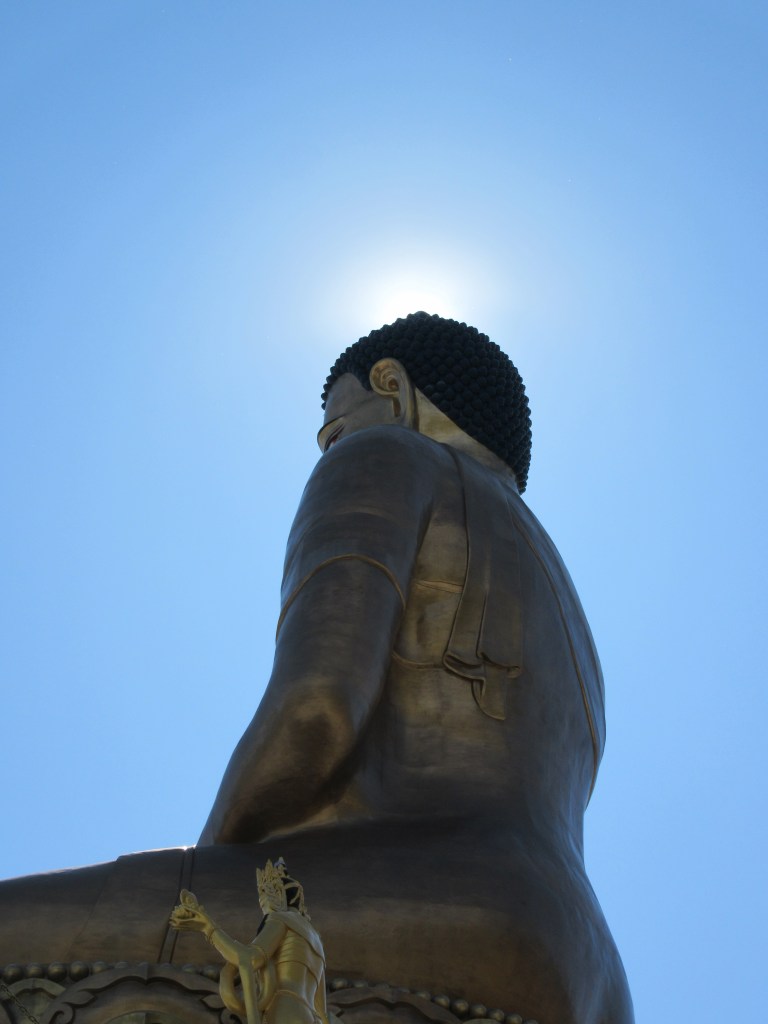
Thinley took this pic. No chance I could pull it off. 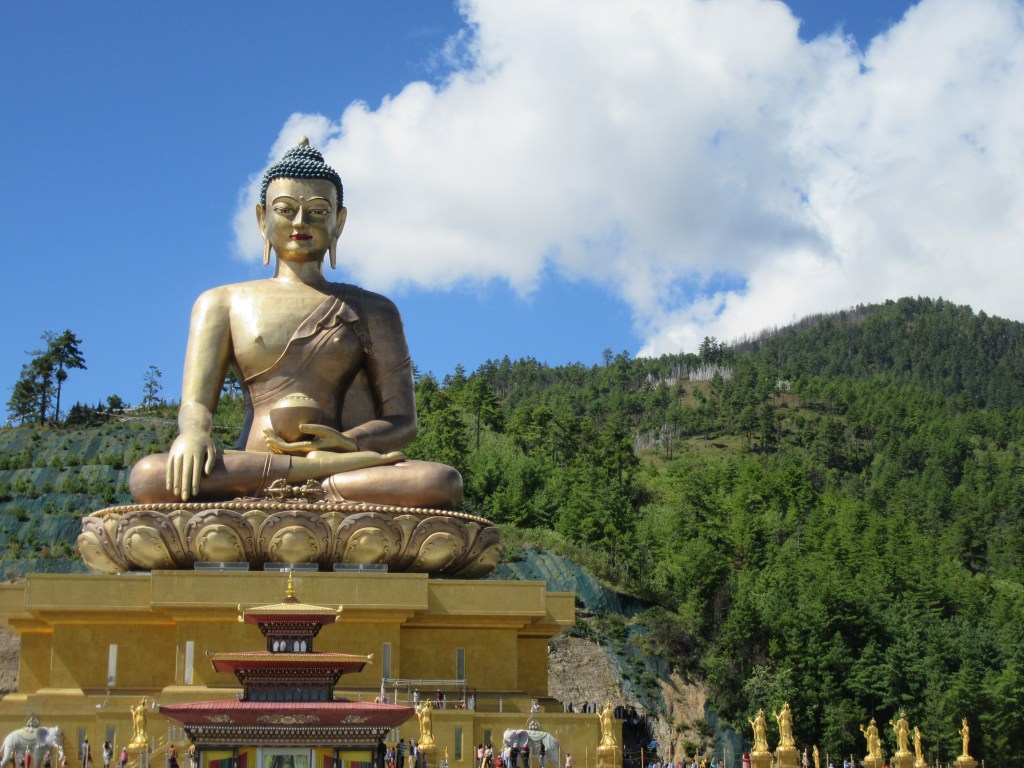
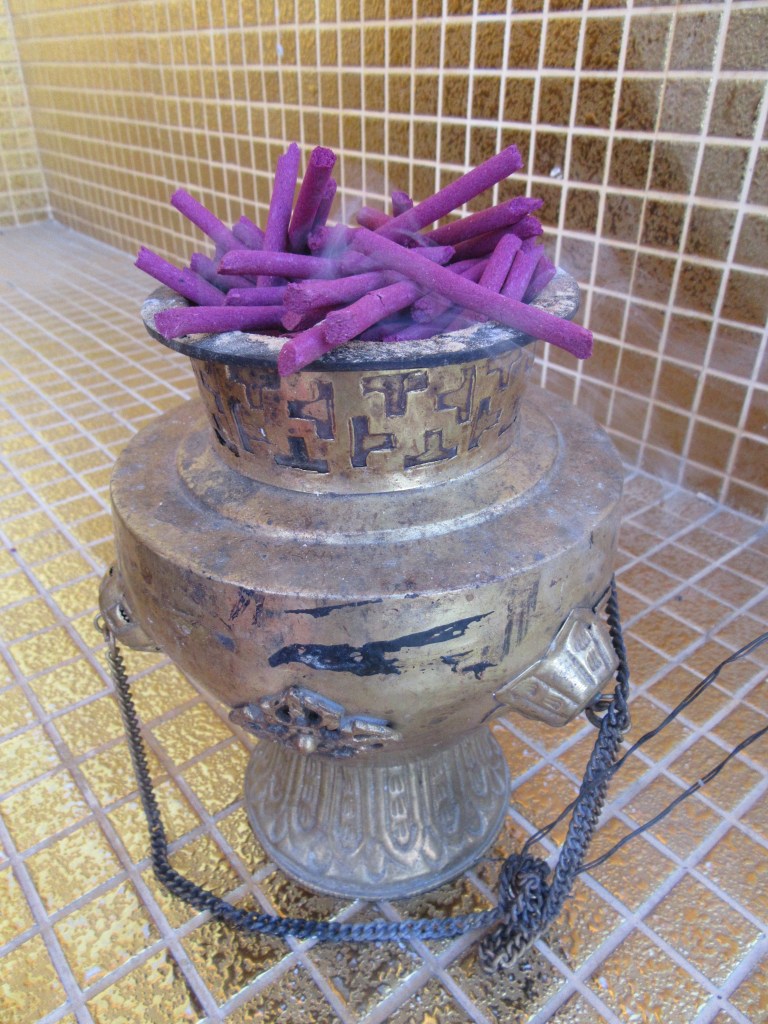
Incense outside of the temple 
Those are people on the stairs. Gives perspective…
On the way back down to town I asked if we could stop at an outdoor recreation area that caught my eye on the way to the big Buddha. You see, here we are way up on a pretty tall hillside and yet there is an outdoor gym. As best I can figure, by the time you walk up to this exercise area you wouldn’t actually need exercise anymore so I’m perplexed by the location. Thinley however is able to clear up all of my confusion. Turns out this high up on the hillside outdoor gym is actually just a really great place to get together with your friends, drink a few (or a lot) of beers, get your dance on and try to not get into (too much) trouble while enjoying the view. Ah, that makes more sense and I’m pretty sure that’s what the WHO was aiming for too. Bhutan. Happy…and human.


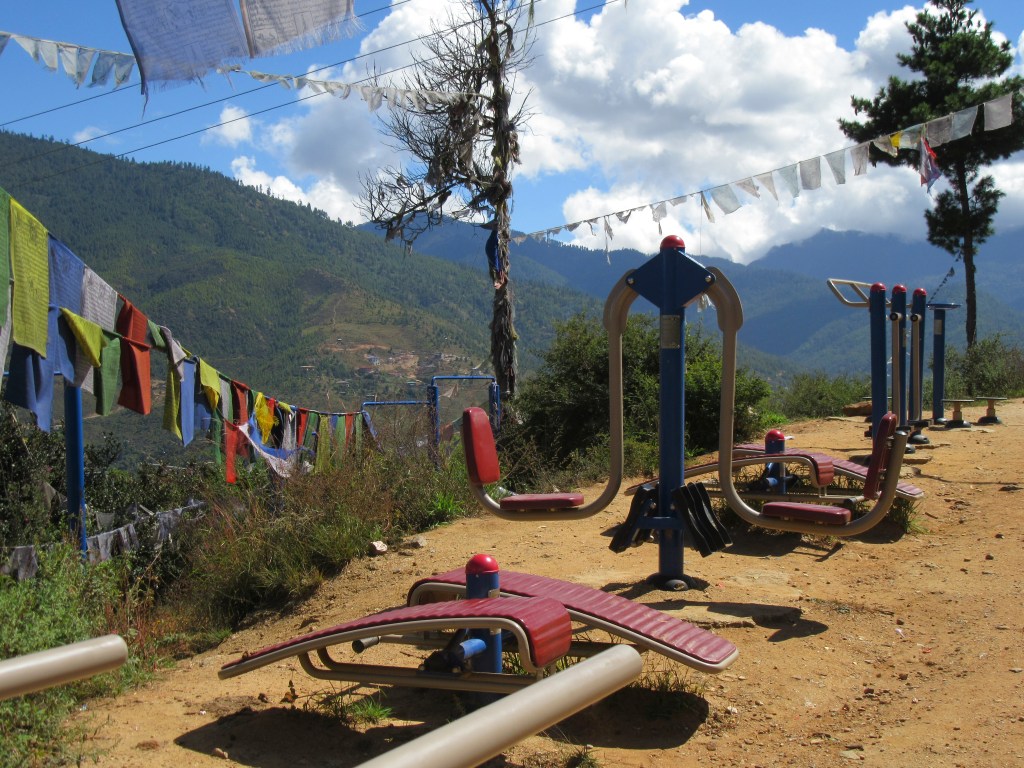
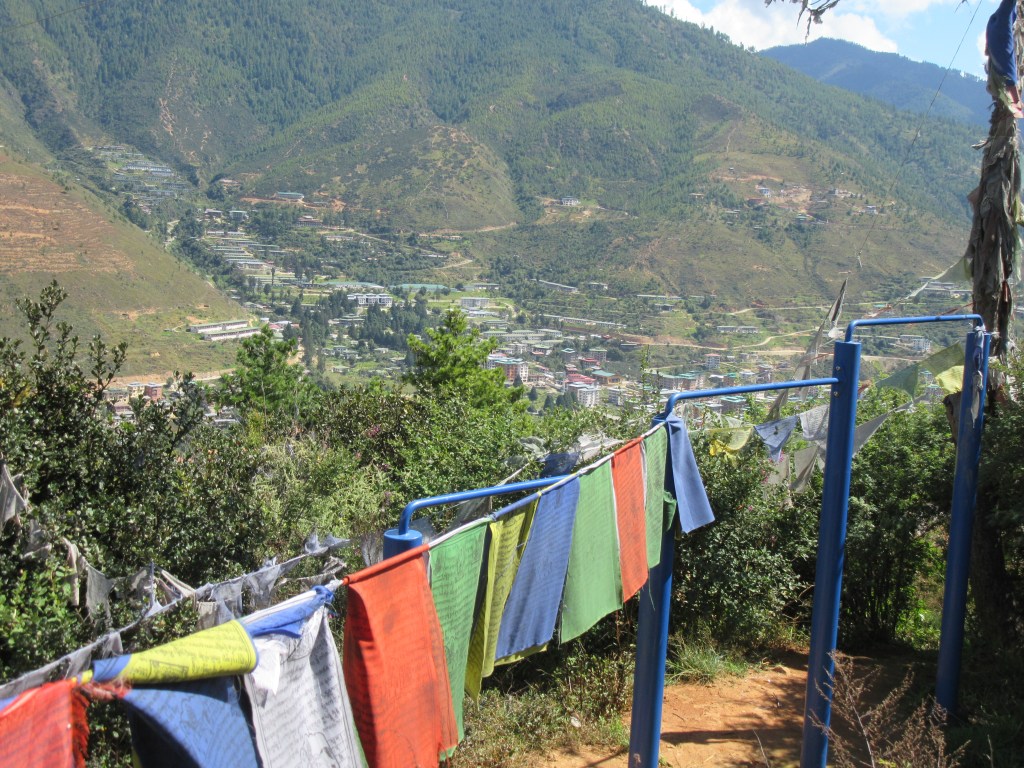

As we’re driving back to town Thinley asks me if I like postcards and stamps and I’m not sure what he’s getting at. Like do I need to buy some to send back home or does he know I’ve been collecting postcards since I was a kid? Turns out neither but Bhutan does have a stamp museum and he wants to know if I’d like to go. Now I’ll be honest, I have my doubts about how interesting this could be but I’m up for anything and off we go to the main Post Office in Thimphu.
And omg was I wrong.
Turns out Bhutan is known for making the most beautiful stamps in the world and they have a pride in their postal service unlike anything I ever imagined. There are stamps with QR codes that play music or movies, there are CD rom stamps and stamps you can play on records, there are silk stamps and stamps that smell like roses and stamps honoring the Bhutanese belief in the Yeti (Thinley still owes me an explanation on this one) and of course lots of stamps honoring the different Kings. I asked my stamp guide how Bhutan decides what stamps to produce and she says with a completely straight face that Bhutan has a stamp designer. There’s just one and he’s 44 years old and he decides what they produce. I mean if that isn’t the most random job in the entire world I don’t know what is but hey, keep it up, he seems to really be on to something. By the end of the tour I was wondering how I’d lived life at all before knowing about Bhutanese stamps. But now I do. And life will have more meaning.
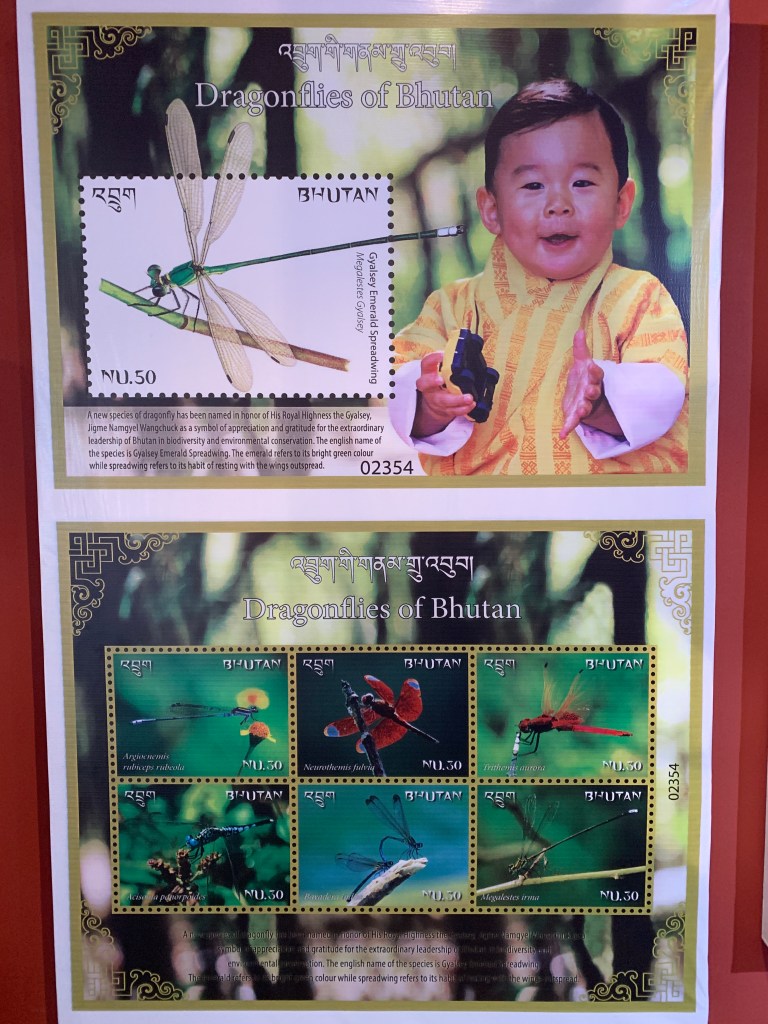
The Royal Prince and the Dragonfly named after him 
QR codes link to videos about Bhutanese wildlife 
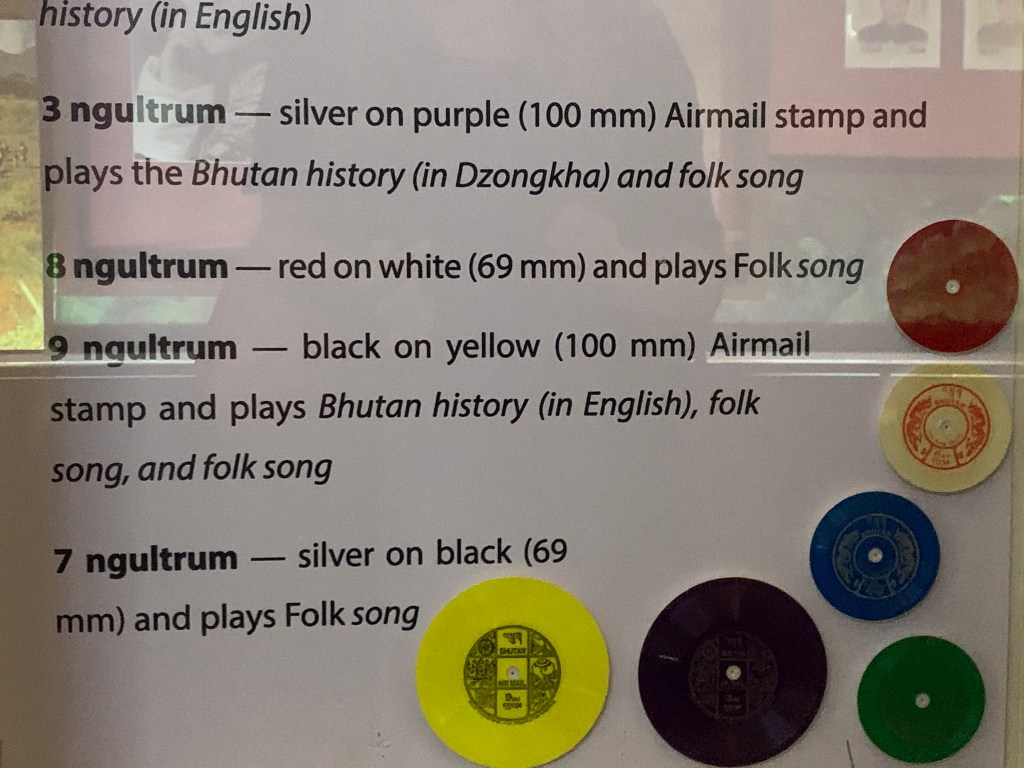
Mini-record stamps 
The Yeti stamp collection…? 
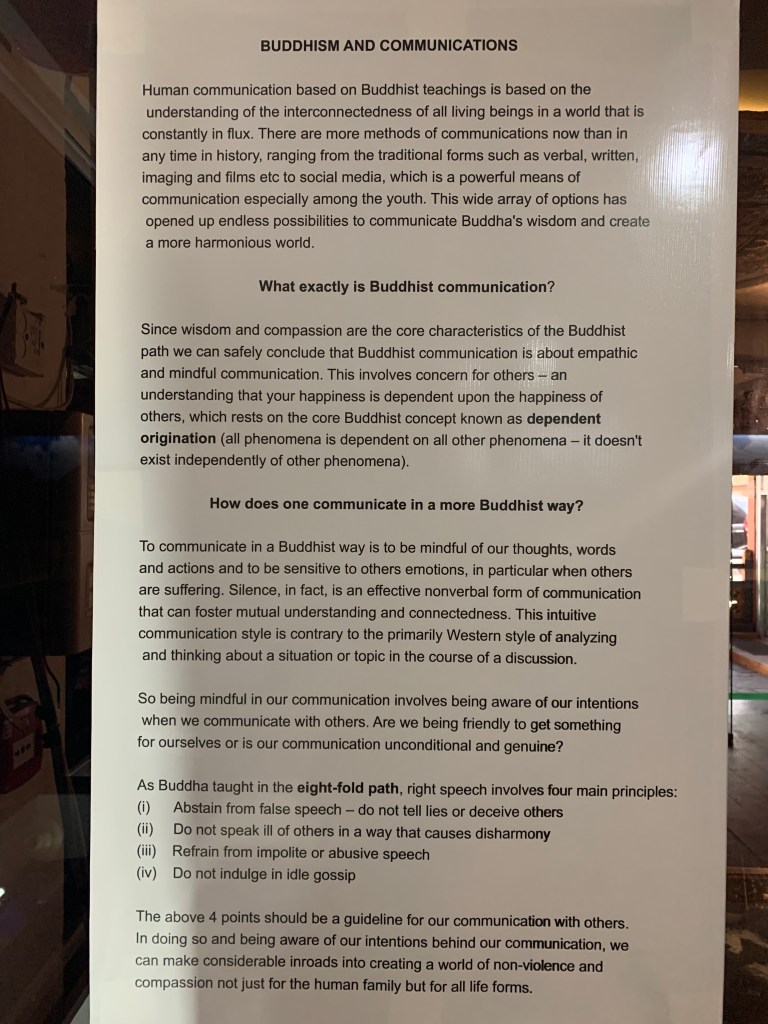
Worth a read, or two.
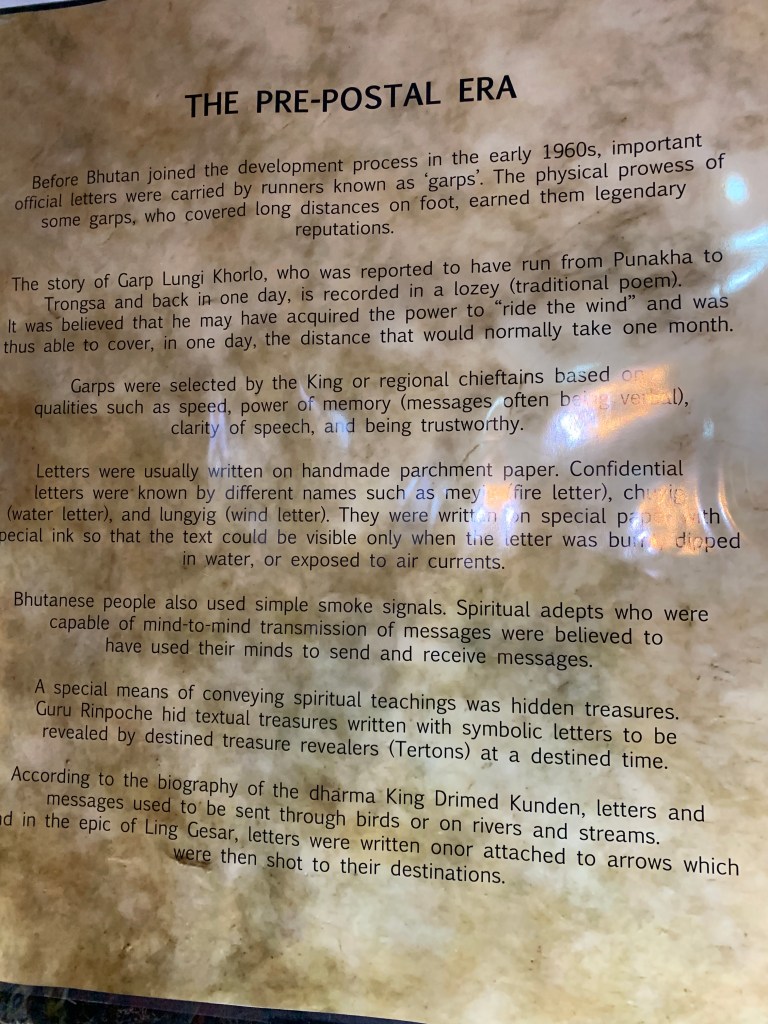
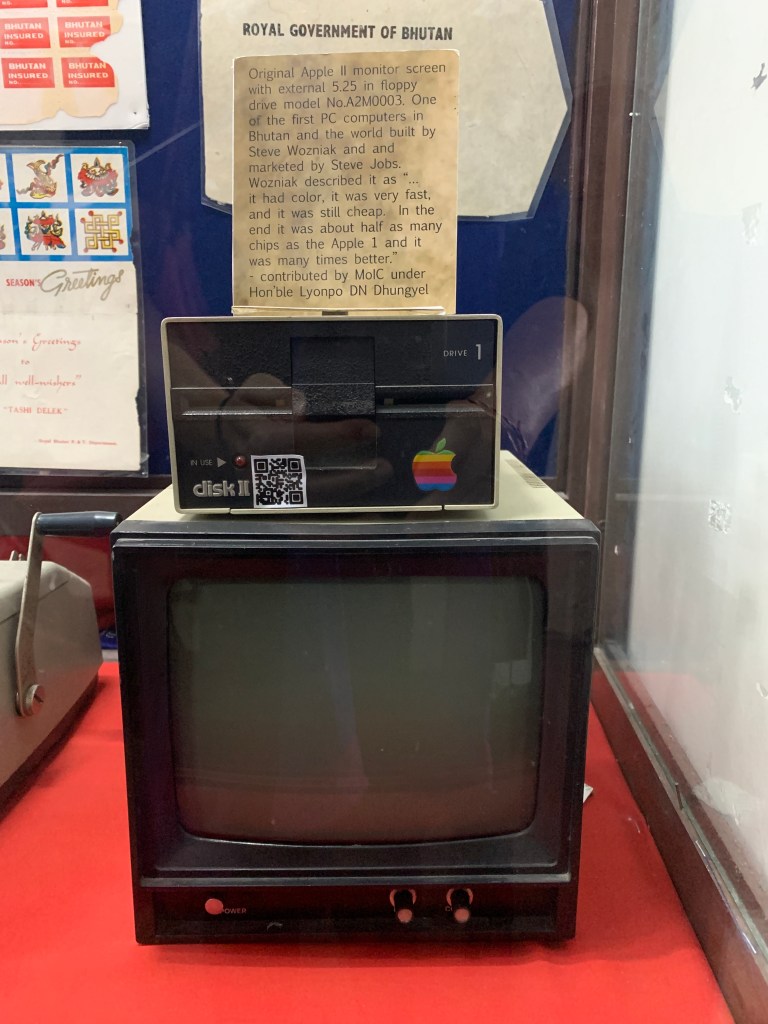
Now I was at a complete loss of words when the stamp tour guide asked me about the postal service in my country, but absolutely intrigued to learn about theirs. There is so much pride in their postal service it’s endearing. The museum showcases a tale of a mail runner that (supposedly) used to be able to run a round trip route of 137km daily and another exhibit to honor a rural mail runner who maintains service in the north part of the country where there are no roads. He retired at 66 years old and his son took over the route and there’s a statue in his honor in the museum. There’s also a vintage mail truck and the first Apple computer used by the Bhutan Post. I mean seriously, it’s just the cutest, sweetest museum ever. So there you go. Stamps and mail. Who knew?



We finished the day with dinner in Thimphu because we were going to karaoke but I had to scrap the plan at the last minute because I was still feeling the elevation. However, we did manage to way to squeeze in a little Friday night adventure at the money exchange. See I’m unable to get any cash out of the ATMs in Bhutan because my card has a chip and chip technology hasn’t made it to Bank of Bhutan’s ATMs yet and they’re the only bank in town. The only way for me to get a little spending cash then is to exchange some USD and while there are money exchanges everywhere, Thinley wants to get me the best exchange rate, and where else to get the best exchange rate but the shoe store. Yep, the shoe store. We walk down the busy main street in town to a small shop with a paper printed sign saying MONEY EXCHANGE taped over the door and nothing but shoes in the store window. But as soon as you walk through the door, there is a money counting machine and stacks, seriously stacks, of Ngultrum on the table in the middle of the store. I really have no idea how this works, and wanted to take a picture but was then worried someone would confiscate my camera so I didn’t, but I did exchange some USD for some Ngultrum at a good exchange rate and well, adventure accomplished for the day.

Around Thimphu 
Around Thimphu 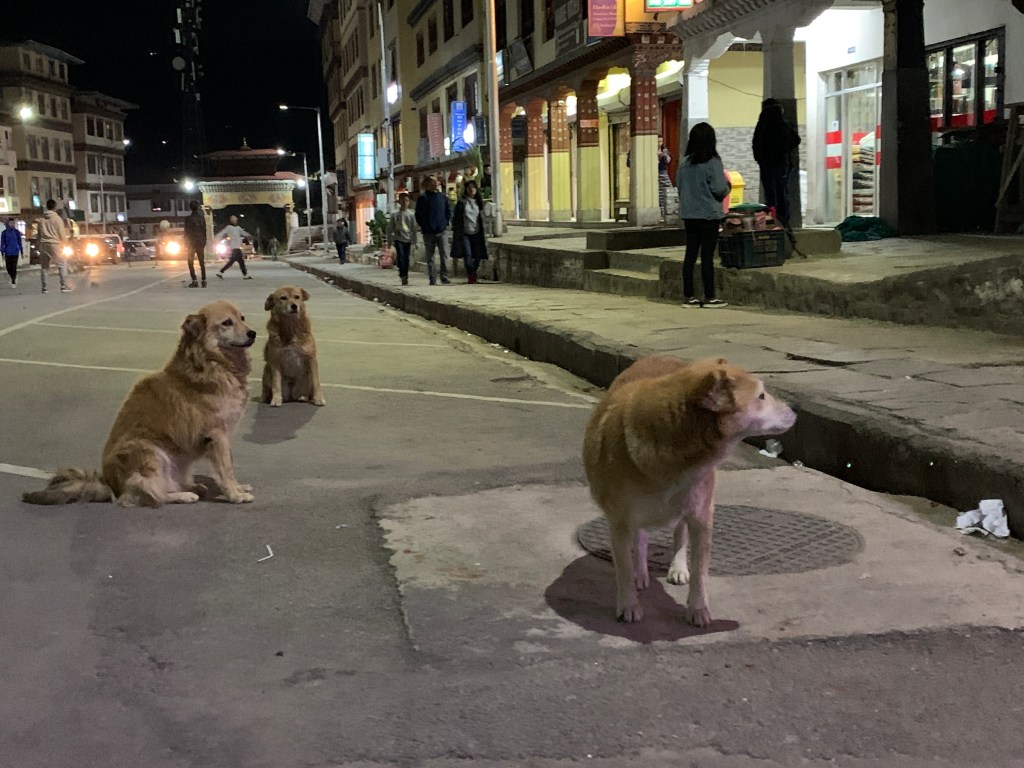
The dogs of Bhutan 
Street Festival 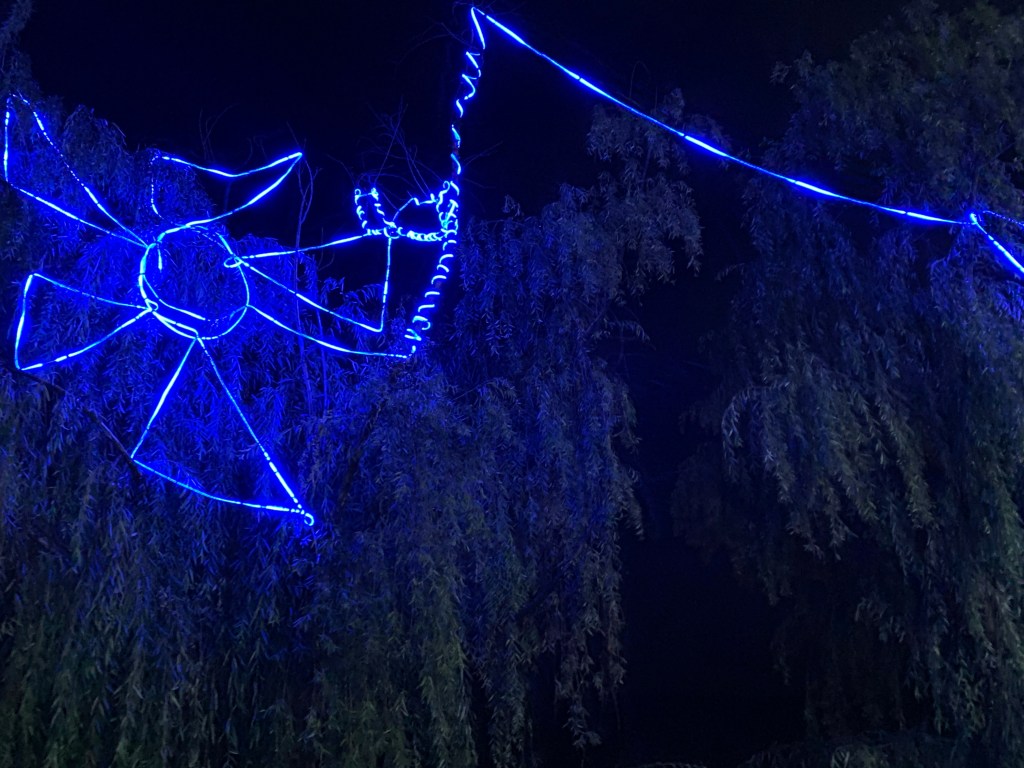
Decorations
Love,
rk
 Buddha & Boots